Best welding jackets: flame-resistant cotton or leather, and when each is enough
Six welding jackets from Lincoln, Tillman, Black Stallion and Miller, compared on fabric, published wash life and coverage, and when leather is worth it.
A welding arc burns exposed skin with ultraviolet light, and every process throws some spatter. The helmet covers your face. A jacket covers the rest of what faces the work.
For flux core and mig at home, a 9 oz flame-resistant cotton jacket is the sensible start: our pick is the Lincoln K2985. Move to leather sleeves or a leather jacket for stick, overhead work or high amperage. Never weld in synthetic fabric, which melts.
What the jackets publish
As published by each maker, checked 2026-09-27. None of these six names ISO 11611, the international standard written for welding clothing, on any page we read.
| Jacket | Body | Leather | Wash life published | Sizes |
|---|---|---|---|---|
| Lincoln K2985 | 9 oz flame-retardant cotton | None | Up to 50 washes | M to 3XL |
| Tillman 6230 | 9 oz Westex FR-7A cotton | None | 50 home, 25 commercial | S to 8X |
| Black Stallion B9C | 9 oz flame-resistant cotton | Snap reinforcements | Not published | S to 5XL |
| Miller Classic 244755 | 9 oz flame-resistant cotton, pre-shrunk | None | Not published | S to 5XL |
| Lincoln K3106 | Flame retardant cloth, 255 g per Lincoln Australia | Split cowhide sleeves | Not published | M to 3XL |
| Lincoln K2989 | 9 oz flame retardant cotton back | Split cowhide chest and sleeves | Not published | M to 3XL |
Sources: Lincoln welding jackets brochure and Australian catalogue; Tillman 6230 spec sheet; Black Stallion B9C page; Miller jackets spec sheet.
Cotton, leather, or both
The American Welding Society’s safety guidance puts it in one line: heavier materials such as leather, or non-melting flame-resistant clothing, are preferable because they are harder to ignite. Both are acceptable. What changes is how much hot metal comes at you.
- Flux core and mig on a bench: spatter is small and brief. Flame-resistant cotton is enough for most people, and it is cooler and cheaper.
- Stick welding: larger, hotter spatter and slag. Leather sleeves are worth it.
- Overhead or vertical work, and high amperage: molten metal falls onto the chest and shoulders. That is the case for full leather.
Two labels that are not welding standards
Some listings print ASTM F1506 or NFPA 2112. ASTM F1506 covers flame-resistant and electric-arc-rated clothing for workers exposed to flames and electric arcs, meaning electrical work. NFPA 2112 covers flash fire. Neither is a welding clothing standard, and none of the jackets here claims either. Tillman cites a single test method from F1506, and says that is what it is.
Looking after flame resistance
Treated cotton can lose protection with repeated washing, which AWS notes and which is why the two published wash lives above matter. Follow the care label. A jacket that has been bleached or washed well past its stated life is ordinary cotton, and ordinary cotton ignites.
A jacket is one layer. Your feet need safety-toed leather boots, and your hands, neck and lungs need their own cover: see what a welding helmet does not protect against and the welding respirator guide. The whole starting kit, priced against the welder, is in what a starter kit costs.
How we score
Every pick is scored on the same five criteria. We work from published specs, not from bench tests: every figure comes from the manufacturer’s manual, spec sheet or current listing at write time, with the model number and the date checked. We never estimate a number a manufacturer does not publish.
Specs published
Whether the manufacturer publishes what a buyer needs: duty cycle at a stated amperage, input amp draw, and the breaker the machine requires. A missing number costs points and is marked "Not published".
Arc time
Duty cycle (the share of a ten minute window a machine can weld before it must cool, rated at 104 F under IEC 60974-1) converted into minutes of arc per ten at a working amperage.
Build & parts
Wire drive, torch and leads, and whether consumables and spare parts are easy to buy. Owner reports are attributed to their source and never presented as our testing.
Power fit
Input voltage options and amp draw set against the circuits a home garage usually has. The work of adding a circuit belongs to a licensed electrician.
Value & warranty
What you get for the price, weighted by warranty length and how the brand handles service and parts.
Price bands, relative to the picks on this page: $ budget · $$ mid-range · $$$ premium · $$$$ top shelf. Amazon prices move constantly, so we show bands rather than dollar amounts; each button shows the live price.
Best for most home welders
Lincoln Electric K2985 FR cloth welding jacket
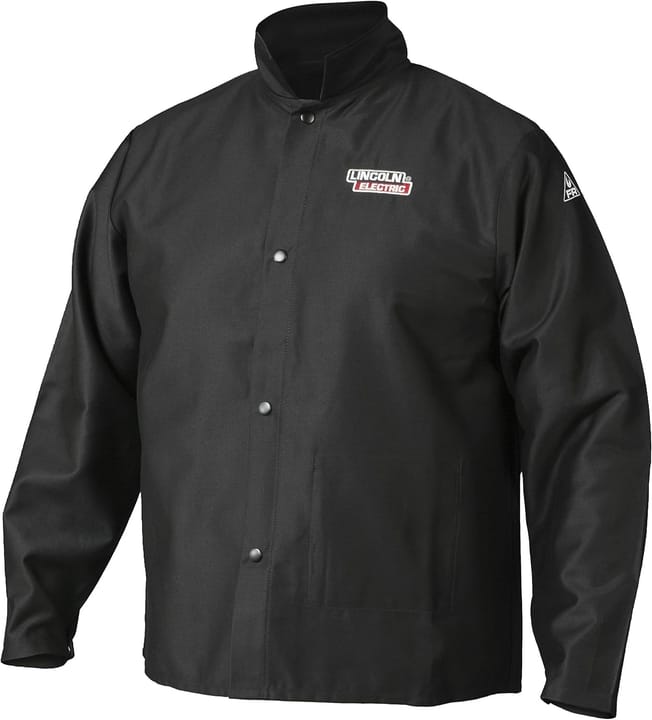
A 9 oz flame-retardant cotton jacket, and one of only two here whose maker publishes a wash life: Lincoln says it keeps its flame retardant properties for up to 50 washes. That is the figure that tells you when a treated jacket stops being what you bought. Lincoln's brochure lists sizes M to 3XL. It is cloth throughout, so it suits flux core and mig at home and is light enough to wear for an afternoon. Lincoln does not name a safety standard or state whether the cotton is treated or inherently flame-resistant.
Pros
- Published wash life: up to 50 washes
- 9 oz flame-retardant cotton, machine washable
- Long sales record and widely stocked sizes
Cons
- No safety standard named
- Smallest size listed is M
- No leather, so heavy spatter from stick can mark it
Best documented, widest size range
Tillman 6230 FR cotton welding jacket
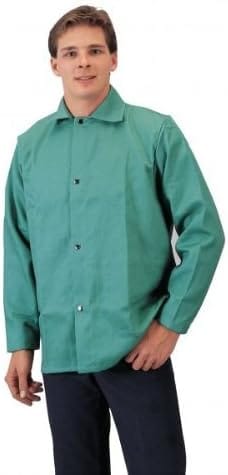
Tillman's spec sheet says more than anyone else's: 9 oz Westex FR-7A flame resistant cotton, 30 inches long, flame resistance maintained for up to 50 home washings at 145 F or 25 commercial washings, and a pass on the ASTM D6413 char length test. That test is one requirement of the ASTM F1506 standard, not a claim of full compliance, and Tillman says so. Sizes run from S to 8X, the widest range here. The Amazon listing we link is the XL and shows no review count, so we ranked it on the strength of its documentation.
Pros
- Named fabric, wash life and test method all published
- Sizes S to 8X
- Lowest price band here
Cons
- Listing shows no review count
- Collar style not published
- Cloth only, no leather reinforcement
Most coverage at the front and neck
Black Stallion BSX B9C contoured FR cotton jacket
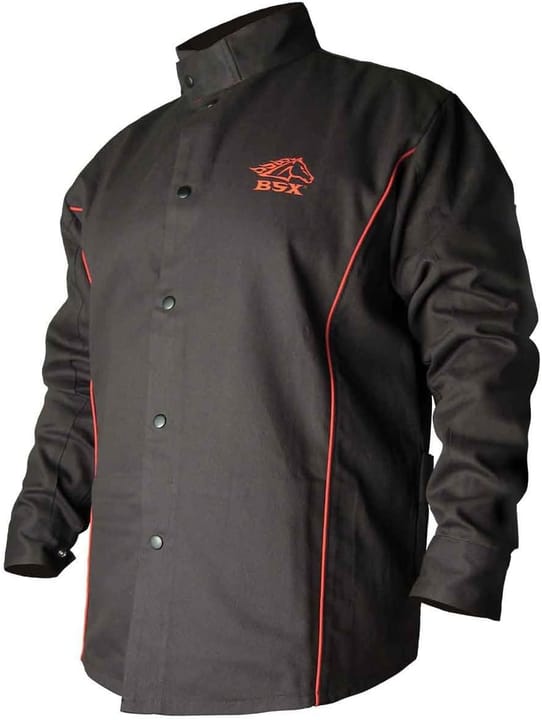
9 oz flame-resistant cotton with an extended 32 inch front and a stand-up welder's collar that snaps closed, which is the part that protects the throat, where most beginner ultraviolet burns show up. Black Stallion puts leather reinforcement on the snaps and offers sizes from S to 5XL. It publishes no wash life and names no standard.
Pros
- 32 inch front length
- Stand-up collar with adjustable snaps
- Sizes S to 5XL
Cons
- No wash life published
- No safety standard named
- Leather only on the snaps
Plain and pre-shrunk
Miller Classic cloth welding jacket (244755)
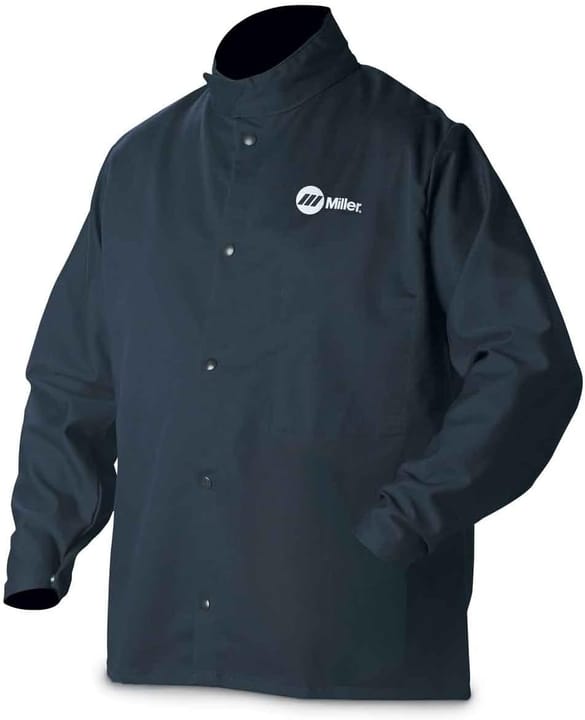
Nine-ounce flame-resistant navy cotton, pre-shrunk, in sizes S to 5XL. Miller's spec sheet mentions a lifetime flame-resistance guarantee, but that applies to its Indura line and not to this Classic jacket. No wash life is published. The linked listing is the 3XL; each size is a separate listing on Amazon, so check the size before ordering.
Pros
- Pre-shrunk 9 oz flame-resistant cotton
- Sizes S to 5XL
- Low price band
Cons
- Linked listing is one size, 3XL
- No wash life for this jacket
- Length and collar not confirmed from Miller's documents
Leather where the spatter lands
Lincoln Electric K3106 leather sleeved jacket
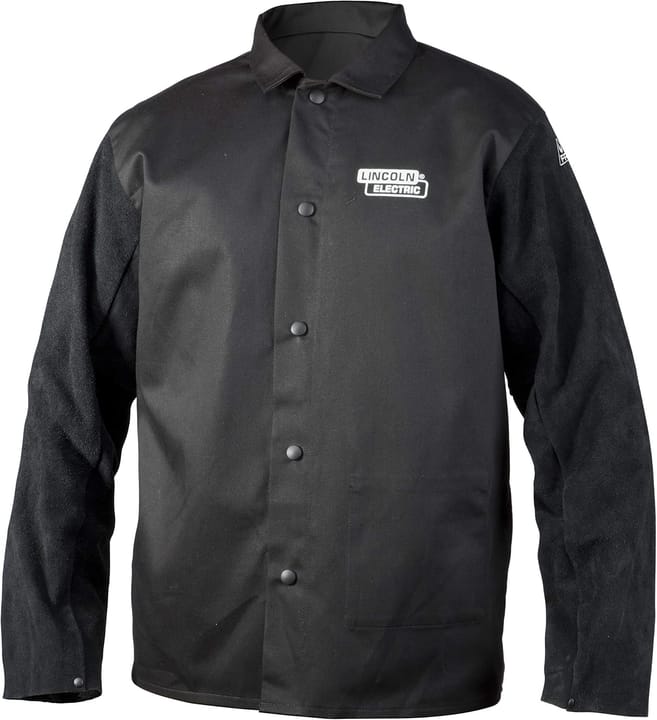
Split cowhide sleeves on a flame retardant cloth body. Sleeves take most of the spatter in bench work, so this puts leather where it earns its weight while keeping the back cooler than a full leather coat. Lincoln's Australian catalogue gives the body as 255 grams of flame retardant material; we could not confirm the 9 oz figure some US listings use. A sensible step up for stick welding or longer mig sessions.
Pros
- Split cowhide sleeves
- Cooler than full leather
- Sizes M to 3XL
Cons
- Body fabric weight differs between Lincoln's sources
- No wash life published
- No safety standard named
For stick, overhead and high amperage
Lincoln Electric K2989 heavy duty leather jacket
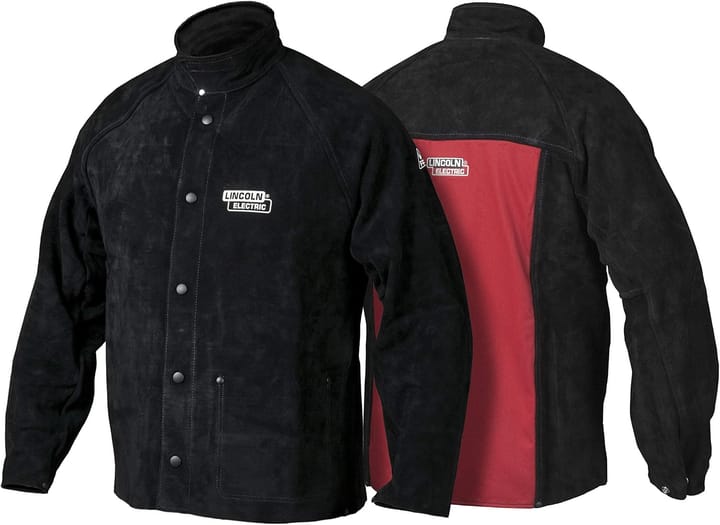
Heavy split cowhide on the chest and sleeves, a 9 oz flame retardant cotton back for ventilation, and a flip-up collar secured with hook and loop. This is the jacket for work that throws spatter at you: stick at higher amperage and anything overhead, where molten metal falls. It is far more than flux core at home needs, and it costs about three times the Lincoln cotton jacket.
Pros
- Leather chest and sleeves
- Cotton back for ventilation
- Closing collar
Cons
- Top price band
- Hot and heavy for light work
- No safety standard named
Also worth considering
Strong, well-reviewed products that just missed our ranked list - worth a look if the picks above aren't quite right for you.
- QeeLink split cowhide leather welding jacket - Full leather with Kevlar stitching at a budget price. QeeLink's own website no longer loads, so we could only read an archived copy of its page.
Frequently asked questions
Is a flame-resistant cotton jacket enough for flux core?
For light home work, the AWS safety guidance treats chemically treated or inherently flame-resistant clothing and leather as the preferred materials, and says jackets should protect your arms and neck from ultraviolet and burns. Flux core throws more spatter than gas mig, so keep the collar closed and add leather sleeves or an apron if spatter burns through at your settings.
Can I weld in a regular hoodie?
Not in synthetic fabric. The AWS safety fact sheet and the Z49.1 welding safety standard both say materials that can melt and cause severe burns should not be worn when welding or cutting. Polyester and nylon blends melt. Untreated cotton does not melt but ignites more easily, which is why the guidance favours treated flame-resistant cotton.
Does washing ruin a flame-resistant jacket?
It can wear down a treated finish. AWS says treated clothing may lose some of its protective characteristics after repeated washing, and to follow the maker's care instructions. Only two jackets here publish a figure: Lincoln says its K2985 keeps its flame retardant properties for up to 50 washes, and Tillman says 50 home washes at 145 F for the 6230.