Best welder for beginners: start with the outlet you have
Five beginner welders compared on what they need from your outlet. Only one is rated for a 20 amp household circuit. Plus what else you must buy to start.
You want to build a welding table or fix a gate, and you have never struck an arc (the arc is the electrical discharge that melts the metal). Every listing says “beginner friendly” and “110v”. Here is the part they leave out.
Start with a wire feed flux core welder, and choose it by what your outlet can supply. Of the five machines here, only the Lincoln 90i FC is rated by its maker to deliver its full output on a 20 amp household circuit. The two cheapest “110v” machines list 47 to 54 amps of input.
Which kind of welding do you need?
- Flux core. Wire feeds from a spool through a gun when you pull the trigger. The wire has a core that shields the molten metal, so there is no gas bottle. Simplest and cheapest to start. It spatters and leaves a crust called slag that you chip off.
- Mig. Same gun and wire feed, with shielding gas from a cylinder. Cleaner welds, better on thin sheet, more to buy.
- Stick. A clamp holds a consumable rod. Cheap and good outdoors, harder to learn.
- Tig. A tungsten electrode in one hand, filler rod in the other. Precise and slow. Not a first process for most people.
For tables, carts, gates and brackets in mild steel, flux core or mig is the usual starting point. The longer comparison is in mig vs tig vs stick, and each type has its own explainer: flux core welders and mig welders.
The numbers
All figures as published by the manufacturer, checked 2026-09-19. Duty cycle is the share of ten minutes a machine can weld before cooling; see duty cycle as minutes of arc.
| Machine | Rated output | Minutes of arc per ten | Max input amps | Circuit the maker states | Gas mig |
|---|---|---|---|---|---|
| Lincoln 90i FC | 90 A at 30 percent | 3 | 21 (spec sheet says 20) | 20 A branch circuit | No |
| YesWelder FLUX-135PRO | 135 A at 60 percent | 6 | 54 | 50 A breaker, in troubleshooting | No |
| ARCCAPTAIN MIG135 | 60 percent, amperage not published | 6 | 47.6 (rated input) | 50 A branch circuit | No |
| YesWelder MIG-205DS, 110 V | 160 A at 60 percent | 6 | 43 | Not published | Yes |
| ARCCAPTAIN MIG200, 110 V | 60 percent, amperage on graph only | 6 | 44.2 (rated input) | Breaker over 50 A | Yes |
Sources: Lincoln operator’s manual IMT10639 (Lowe’s copy); YesWelder FLUX-135PRO manual (ManualsLib); ARCCAPTAIN MIG135 manual (ManualsLib). The two dual voltage machines are covered in full in best multiprocess welders.
The budget machines claim twice the Lincoln’s arc time. They also ask for a circuit most homes do not have. A household outlet tops out near 2,400 watts, as explained in 110v vs 220v welders. The Lincoln is rated inside that limit. The others are rated outside it and will give you some unpublished fraction of their output.
Best welder for home use
If home means ordinary outlets and no plan to change that, buy the Lincoln. If you own the house and will weld often, get a quote for a 240 volt welder circuit first (what to tell the electrician), then buy a dual voltage machine.
Best 110v welder
For full rated output from a standard outlet: the Lincoln. For the lowest cost of entry, accepting reduced output: the FLUX-135PRO or MIG135.
The welder is the small part of the bill: see what a starter kit costs. New to all of this? Welding for beginners sets out the order to do things in, and how to weld covers the first session.
Safety, stated plainly
A welding arc emits ultraviolet light that burns eyes and exposed skin in seconds. Sparks travel and start fires. Flux core produces a lot of fume. A helmet set to the right shade for your amperage, gloves and covered skin are required, not optional, and fume needs moving air that carries it away from your face. Clear anything flammable from the area and keep an extinguisher within reach. This gear reduces specific hazards. It does not make welding safe.
How we score
Every pick is scored on the same five criteria. We work from published specs, not from bench tests: every figure comes from the manufacturer’s manual, spec sheet or current listing at write time, with the model number and the date checked. We never estimate a number a manufacturer does not publish.
Specs published
Whether the manufacturer publishes what a buyer needs: duty cycle at a stated amperage, input amp draw, and the breaker the machine requires. A missing number costs points and is marked "Not published".
Arc time
Duty cycle (the share of a ten minute window a machine can weld before it must cool, rated at 104 F under IEC 60974-1) converted into minutes of arc per ten at a working amperage.
Build & parts
Wire drive, torch and leads, and whether consumables and spare parts are easy to buy. Owner reports are attributed to their source and never presented as our testing.
Power fit
Input voltage options and amp draw set against the circuits a home garage usually has. The work of adding a circuit belongs to a licensed electrician.
Value & warranty
What you get for the price, weighted by warranty length and how the brand handles service and parts.
Price bands, relative to the picks on this page: $ budget · $$ mid-range · $$$ premium · $$$$ top shelf. Amazon prices move constantly, so we show bands rather than dollar amounts; each button shows the live price.
Best for a normal household outlet
Lincoln Electric WELD-PAK 90i FC (K5255-1)
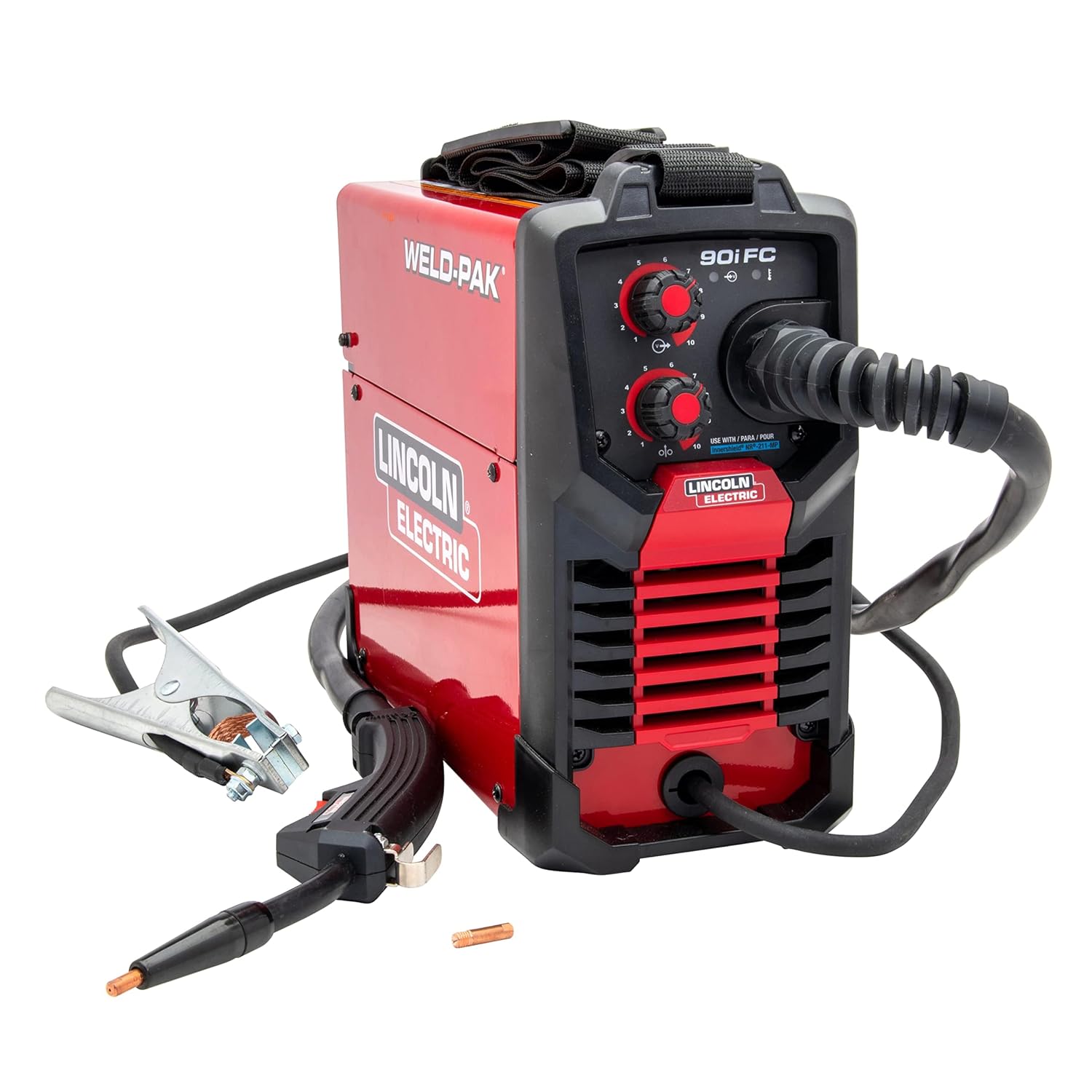
The only machine on this page whose manual says its rated output is available when connected to a 20 amp branch circuit. It ships with an ordinary household plug. Rated output is 90 amps at 30 percent, which is three minutes of arc in every ten, and the rating plate cites IEC 60974-1. Lincoln also prints extension cord limits: 25 feet on 14 AWG and 50 feet on 12 AWG. It is flux core only, so no gas bottle and no gas mig later. It weighs 15 pounds. The warranty is 12 months, the shortest here.
Pros
- Rated output available on a 20 A branch circuit, per the manual
- I1max, I1eff, test standard and extension cord limits all published
- Simple two knob setup with a settings chart in the lid
Cons
- Flux core only, with no upgrade path to gas mig
- Published chart covers 20 gauge to 1/8 inch; the 1/4 inch maximum has no stated conditions
- 12 month warranty
Best low cost way to try welding
YesWelder FLUX-135PRO
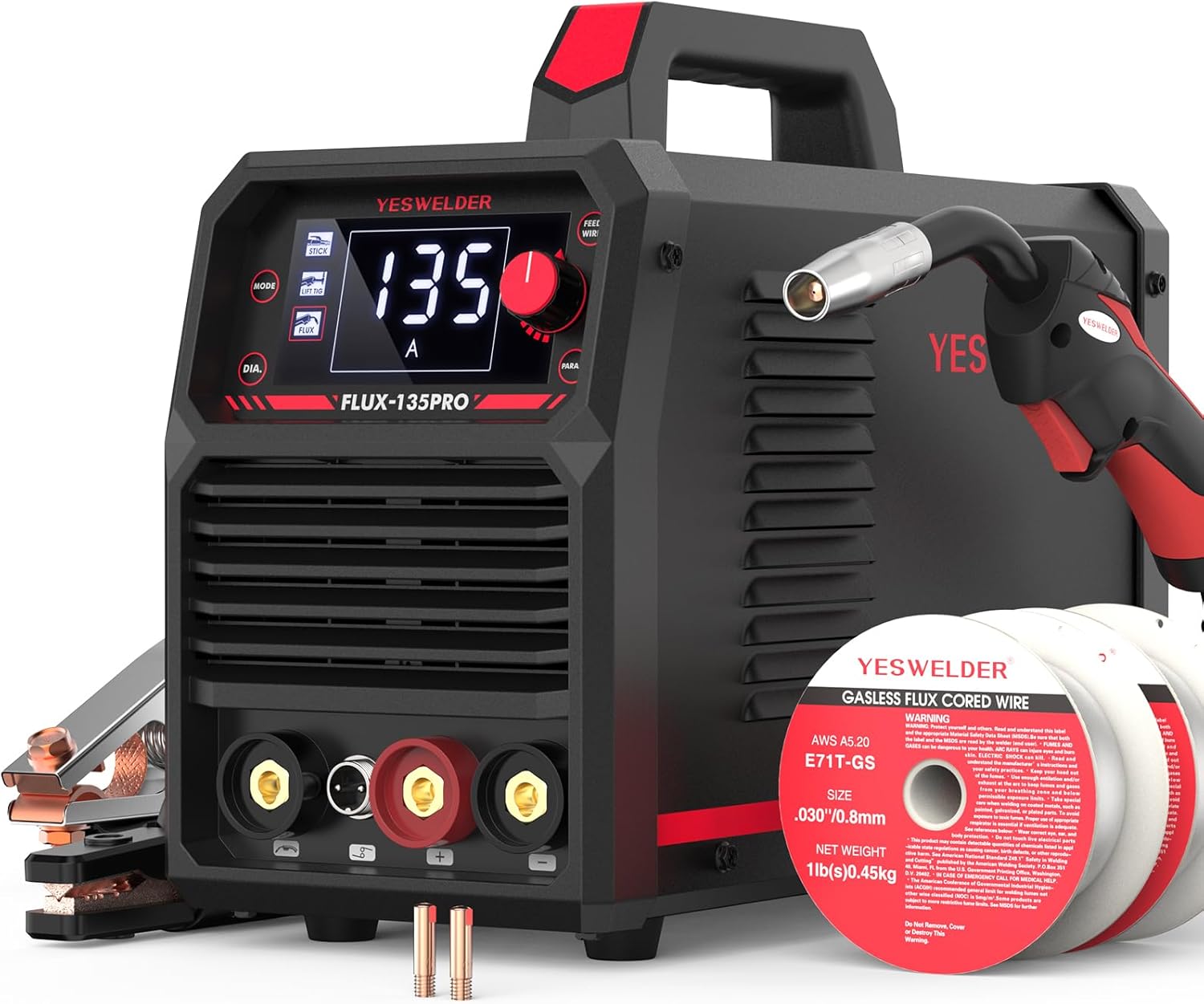
An 11 pound flux core machine that also runs stick, at roughly a third of the Lincoln's price. YesWelder rates it 135 amps at 60 percent and publishes the input side honestly: I1max of 54 amps and I1eff of 40 on 110 volts, and the troubleshooting section refers to a 50 amp time-delay breaker on a dedicated circuit. On a household outlet it will work at lower settings. How much lower is not published. Treat it as a learning tool for thin steel, and expect tripped breakers if you turn it up.
Pros
- Duty cycle published with amperage and voltage for each process
- I1max and I1eff both in the manual
- Two year warranty; stick and lift tig modes included
Cons
- 54 A maximum input on a machine sold as 110 V
- Output available on a 15 or 20 A outlet is not published
- Manual says not to use it on a GFI outlet, which many garages have
Lightest, with the clearest circuit warning
ARCCAPTAIN MIG135
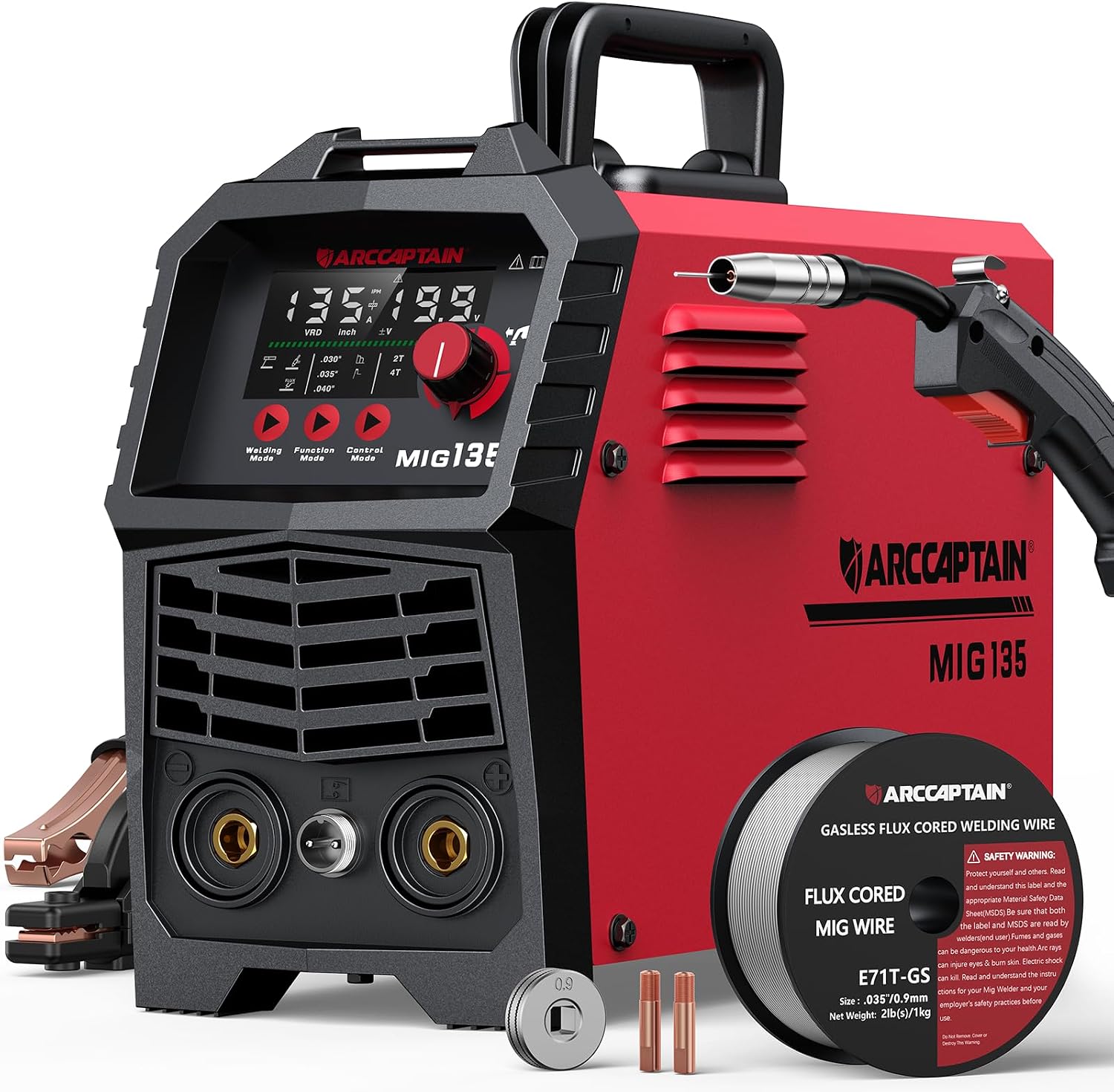
Similar in price and idea to the YesWelder, and under 10 pounds. ArcCaptain's manual is direct about power: connect it to a 50 amp branch circuit for full performance, and on a lower capacity circuit expect reduced welding current and duty cycle. Rated input current is 47.6 amps at 5.8 kVA. It names IEC 60974-1 and states a 60 percent duty cycle, but not the amperage that figure applies to, and no maximum material thickness is published.
Pros
- Manual states plainly what a smaller circuit costs you
- Names the test standard; two year warranty
- Synergic mode sets wire speed and voltage from thickness
Cons
- 47.6 A rated input on 110 V
- Duty cycle amperage and maximum thickness not published
- Gasless only in wire feed mode
Best if you will add a 240 volt circuit
YesWelder MIG-205DS
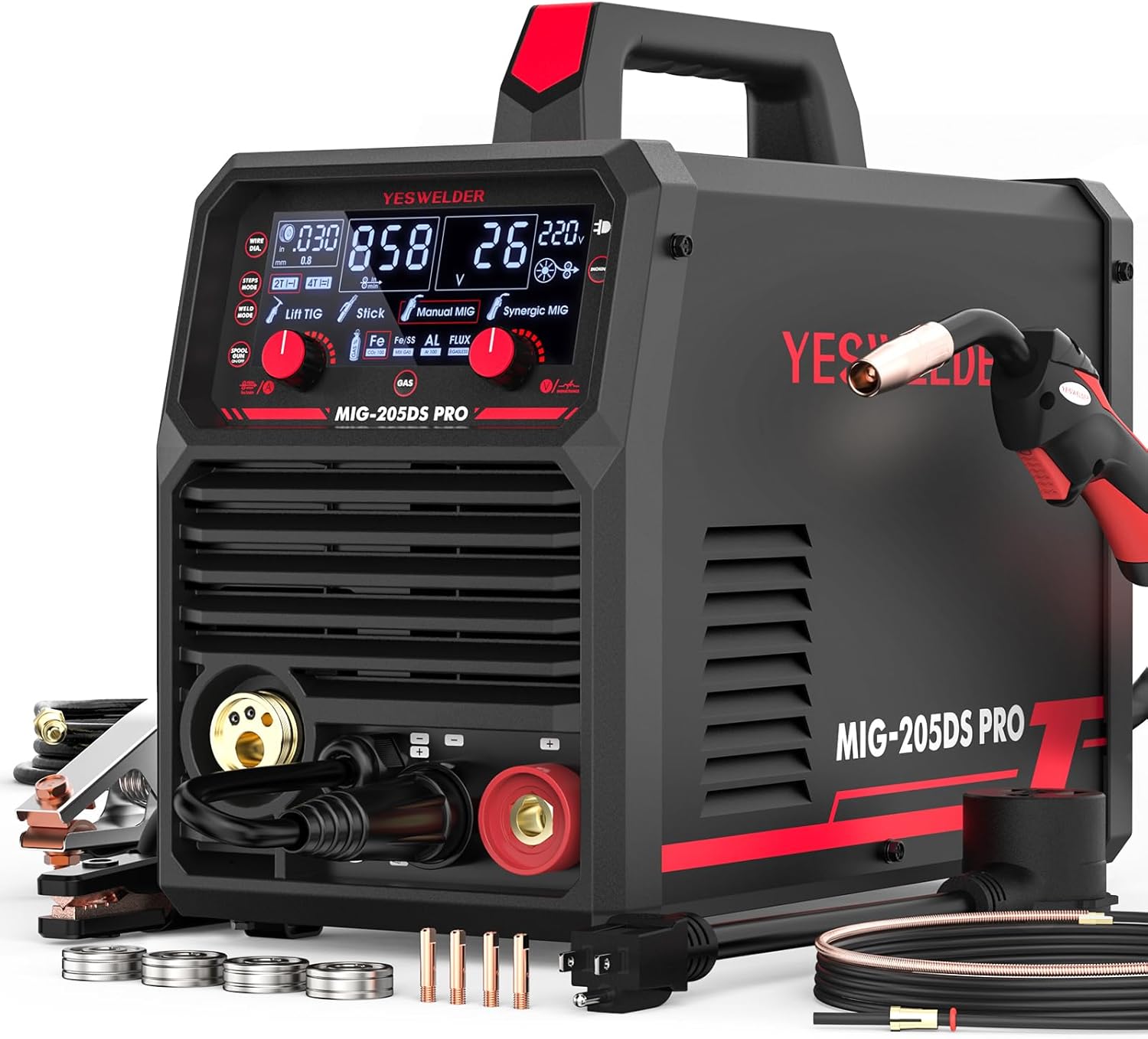
Costs about the same as the Lincoln and does far more once it has a 240 volt circuit behind it: gas mig, flux core, stick and lift tig, rated 205 amps at 60 percent on 220 volts. That makes it the pick for a beginner who already knows the garage is getting a welder outlet. On 110 volts the manual lists a 43 amp maximum input, so it is not a household outlet machine at full output. Setup has more steps than a flux core box, and gas mig means buying a cylinder and regulator.
Pros
- Room to grow: gas mig, stick and lift tig
- Duty cycle and both input currents published
- Long-running model with a deep owner base
Cons
- 43 A maximum input on 110 V
- No breaker guidance published
- More to set up and more to buy on day one
Runner-up for a 240 volt garage
ARCCAPTAIN MIG200
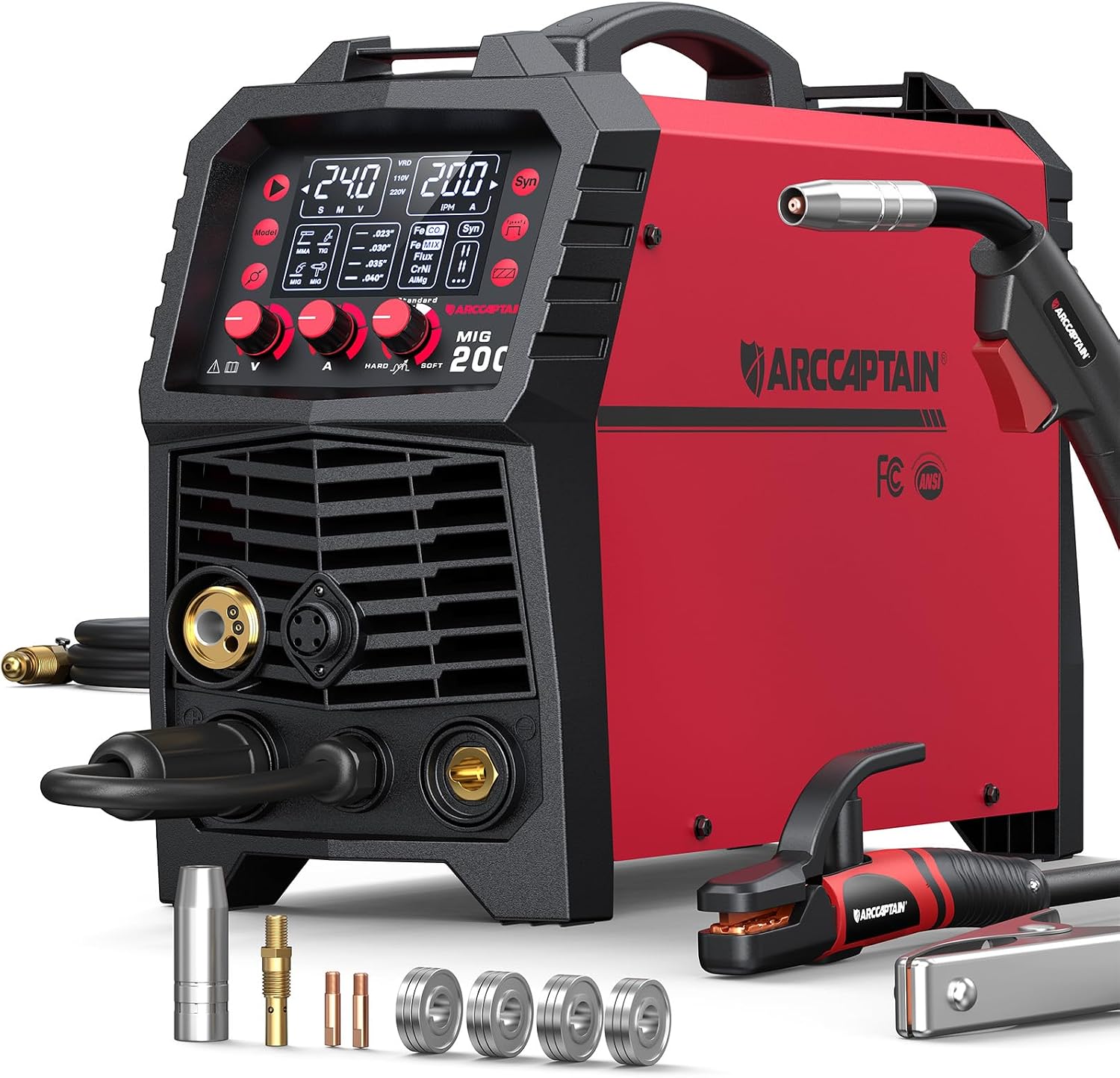
The same kind of machine as the MIG-205DS, with one thing a beginner's electrician will want: a breaker figure in the manual, which recommends a breaker over 50 amps. Rated input is 44.2 amps on 110 volts and 30.9 on 220. A large display and synergic mode make first setup easier. The 60 percent duty cycle is published without a stated amperage in the table, only as a curve.
Pros
- Breaker recommendation published
- Synergic setup and a large, clear display
- Gas mig, flux core, stick and lift tig
Cons
- Duty cycle amperage shown only as a graph
- 44.2 A rated input on 110 V
- I1max and I1eff not split out
Also worth considering
Strong, well-reviewed products that just missed our ranked list - worth a look if the picks above aren't quite right for you.
- Hobart Handler 140EZ - New 120 volt mig and flux core machine from Hobart with a simplified two knob mode. Too few reviews to rank yet.
- Forney Easy Weld 141 FC-i - Current version of Forney's 120 volt flux core welder. New listing, not enough reviews to rank.
Frequently asked questions
What type of welder is easiest for a beginner?
A wire feed welder. You pull a trigger and the machine feeds wire, so you can concentrate on moving steadily. Flux core is the simplest version because the wire carries its own shielding and needs no gas bottle. Mig uses the same gun with a bottle of shielding gas and leaves a cleaner weld. Stick and tig take more practice.
What is the best welder for home use?
The one your home can power. For a garage with ordinary outlets, that points to the Lincoln 90i FC, the only machine here whose manual says its rated output is available on a 20 amp branch circuit. If you have or will add a 240 volt circuit, a dual voltage machine such as the YesWelder MIG-205DS covers thicker steel and adds gas mig.
What is the best 110v welder?
It depends what 110v means to you. If it means a normal household outlet, check the input current. The YesWelder FLUX-135PRO manual lists a maximum input of 54 amps and the ARCCAPTAIN MIG135 lists 47.6, and both refer to a 50 amp breaker. They run on lower settings from a household outlet, and neither maker publishes how much output that gives.
Can a beginner welder fix a trailer or a hitch?
No page on this site will tell you a weld will hold a load. Trailers, hitches, lifting gear and anything under pressure are structural work, and that belongs to a certified welder. Learn on tables, carts, brackets and garden projects.
What else do I need besides the welder?
At minimum: an auto darkening welding helmet, leather welding gloves, a flame resistant jacket or heavy cotton sleeves, safety glasses, closed leather boots, wire, a chipping hammer and wire brush, clamps, an angle grinder and a fire extinguisher within reach. Gas mig adds a cylinder and regulator. Budget for these before choosing the machine.