Best mig welders, ranked by what your circuit can actually feed
Five gas-capable mig welders compared on published duty cycle, input amps and breaker. Two are rated for a 20 amp circuit. Three ask for 50.
Every mig welder listing promises it will plug in at home. The manuals sort these five into two groups, and which group a machine is in matters more than the amps on its badge.
Two of these welders publish a rating that fits a 20 amp branch circuit: the Lincoln POWER MIG 140 MP and the Lincoln Easy-MIG 140. The other three ask for a 50 amp circuit or leave their 110 volt draw unpublished. If you have household outlets only, choose from the first group. If a 240 volt circuit is coming, the second group gives far more output for the money.
Five machines, split by circuit
Mig ratings, as published by each maker, checked 2026-09-19. Minutes of arc per ten is duty cycle times ten. “Not published” means we looked and the maker does not state it.
| Machine | Input | Rated output | Minutes of arc per ten | Input amps as published | Circuit as published |
|---|---|---|---|---|---|
| Lincoln POWER MIG 140 MP | 120 V | 95 A at 60 percent | 6 | 20 (15 effective) | 20 A fuse or breaker |
| Lincoln Easy-MIG 140 | 120 V | 90 A at 20 percent | 2 | 20 | 20 A; 25 A circuit for maximum output |
| YesWelder MIG-250 PRO | 110 V | 175 A at 60 percent | 6 | Not published | Not published |
| 220 V | 250 A at 60 percent | 6 | I1max 34, I1eff 26.3 (220 V version manual) | 50 A time-delay breaker | |
| ARCCAPTAIN MIG160 | 110 V | 120 A at 60 percent | 6 | 47.6 (table) or I1max 36.6 (nameplate) | 50 A branch circuit |
| 220 V | 160 A at 60 percent | 6 | 43.3 (table) or I1max 24.2 (nameplate) | 50 A branch circuit | |
| Weldpro MIG210LCD | 115 V | 120 A at 30 percent | 3 | 35.7 rated; I1eff 24.3 | Not published |
| 230 V | 200 A at 30 percent | 3 | 35.7 rated; I1eff 23 | Not published |
Sources: Lincoln POWER MIG 140 MP manual IMT10392 and Easy-MIG 140 manual IM10049; YesWelder MIG-250PRO manual and product page; ARCCAPTAIN MIG160 manual; Weldpro spec sheet.
Circuit first, then arc time
The circuit column comes first. A household outlet is on a 15 or 20 amp circuit. A machine whose manual asks for 50 will start on that outlet and trip the breaker when you turn it up, and no maker here publishes how far you can turn it. Background: welder amp draw and can my panel handle a welder.
Then arc time. Duty cycle is the share of ten minutes a machine can weld before it must cool. Compare it at the amperage you will use. Six minutes at 95 amps and two minutes at 90 amps are both real, published Lincoln ratings, on the same outlet.
Then the basis. Lincoln’s 140 MP manual says how its 40 C duty cycle was derived. The import brands state 60 percent without saying what temperature it assumes. We print their figures and mark the difference.
New to the process? Start with mig welders explained, and budget for a cylinder: see mig welding gas.
Matching a machine to your garage
Household outlets, and you want the most arc time they allow: the POWER MIG 140 MP. Household outlets and a simple machine for occasional repairs: the Easy-MIG 140. A 240 volt circuit in place or planned, and thicker steel ahead: the MIG-250 PRO. Smallest budget that still runs gas: the MIG160, knowing it wants a bigger circuit to reach its rating.
We score from published specs and attributed owner reports. We do not bench-test, and nothing here says a weld will hold a load. Structural and pressure work belongs to a certified welder. Have a licensed electrician plan any new circuit from the machine’s manual.
How we score
Every pick is scored on the same five criteria. We work from published specs, not from bench tests: every figure comes from the manufacturer’s manual, spec sheet or current listing at write time, with the model number and the date checked. We never estimate a number a manufacturer does not publish.
Specs published
Whether the manufacturer publishes what a buyer needs: duty cycle at a stated amperage, input amp draw, and the breaker the machine requires. A missing number costs points and is marked "Not published".
Arc time
Duty cycle (the share of a ten minute window a machine can weld before it must cool, rated at 104 F under IEC 60974-1) converted into minutes of arc per ten at a working amperage.
Build & parts
Wire drive, torch and leads, and whether consumables and spare parts are easy to buy. Owner reports are attributed to their source and never presented as our testing.
Power fit
Input voltage options and amp draw set against the circuits a home garage usually has. The work of adding a circuit belongs to a licensed electrician.
Value & warranty
What you get for the price, weighted by warranty length and how the brand handles service and parts.
Price bands, relative to the picks on this page: $ budget · $$ mid-range · $$$ premium · $$$$ top shelf. Amazon prices move constantly, so we show bands rather than dollar amounts; each button shows the live price.
Best on a household circuit
Lincoln Electric POWER MIG 140 MP (K4498-1)
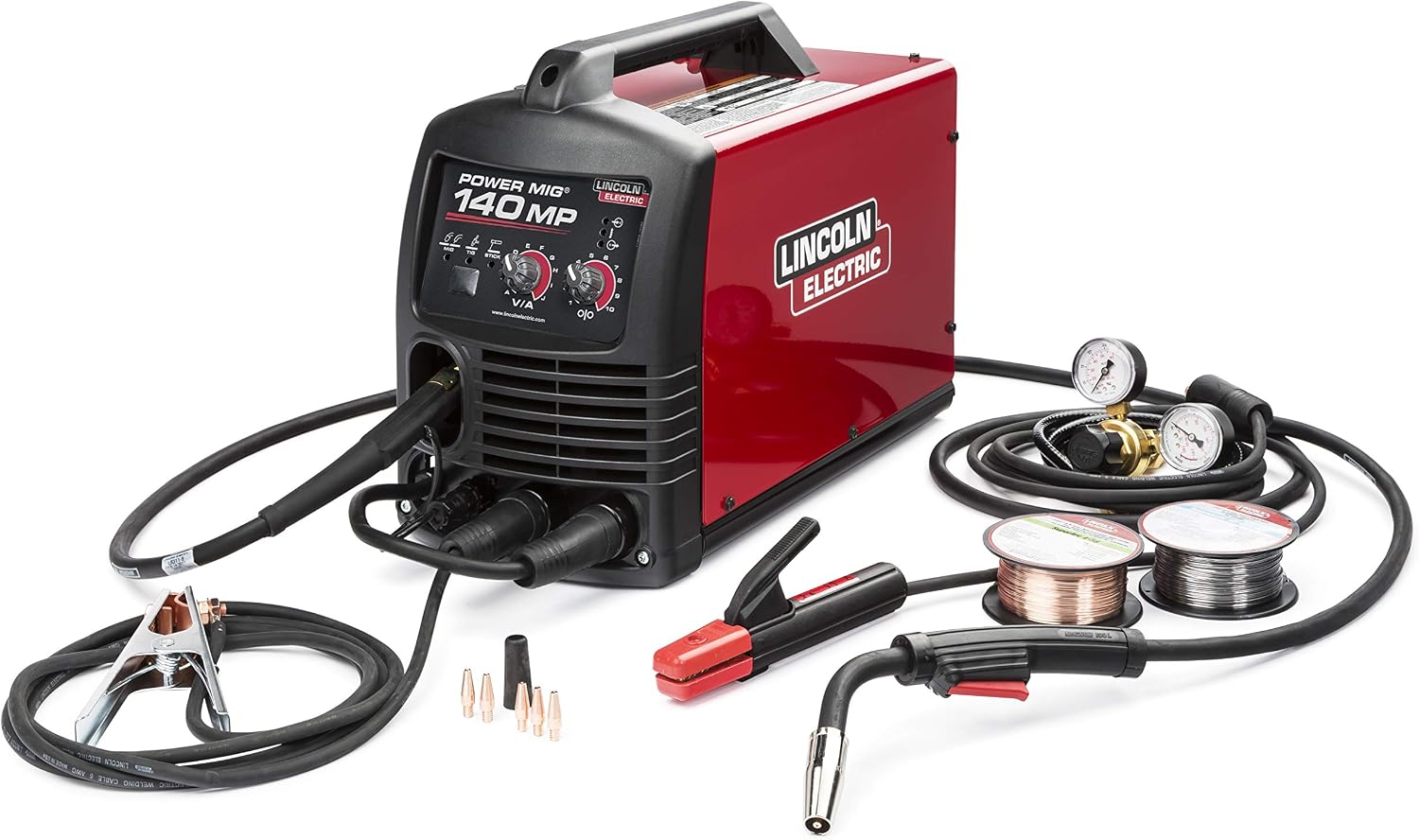
The most completely documented machine here, and the strongest published rating you can run from a 120 volt outlet: 95 amps at 60 percent for mig, which is six minutes of arc in every ten. The manual lists 20 amps of input at that output, 15 amps effective, and a 20 amp fuse or breaker, so its rating fits a 20 amp branch circuit. Lincoln also says how the duty cycle was derived, and publishes extension cord limits and a 3 kW generator minimum. It adds stick and DC tig, weighs 34.5 pounds and carries a three year warranty. It has fewer Amazon reviews than our usual floor. We ranked it on the strength of its documentation.
Pros
- 95 A at 60 percent on 120 V, with the rating basis stated
- 20 A input and a 20 A breaker published; extension cord and generator figures too
- Three year warranty; mig, flux core, stick and DC tig
Cons
- Highest price band on this page
- 120 V only, so no step up when you add a 240 V circuit
- Spec sheet and manual give different low ends for the mig range
Simplest, with honest numbers
Lincoln Electric Easy-MIG 140 (K2697-1)
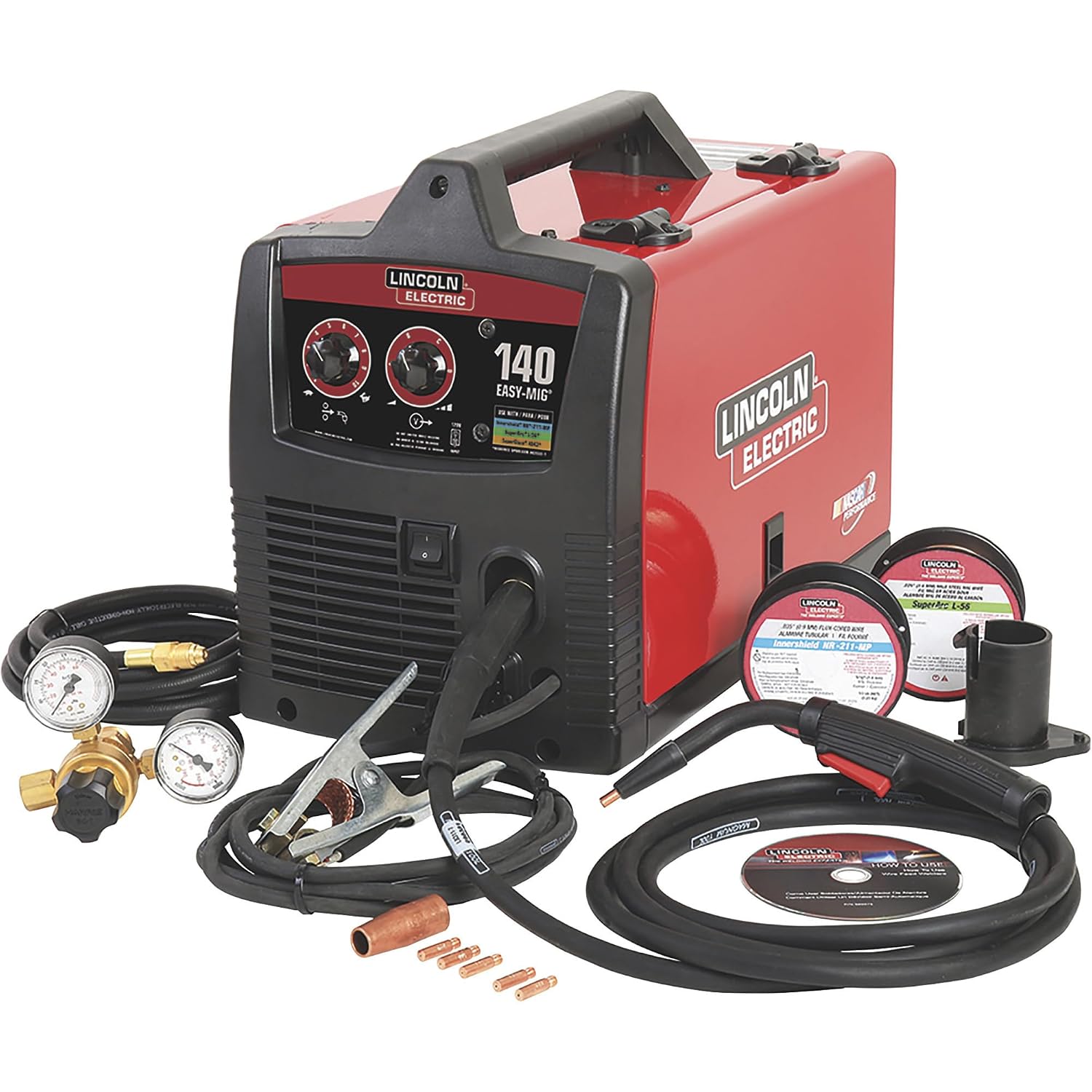
Two knobs, a chart inside the door and a long service record. Lincoln rates it 90 amps at 20 percent, two minutes of arc in every ten, drawing 20 amps, and lists a 20 amp fuse or breaker. A footnote in the manual is unusually frank: to use the machine's maximum output, a branch circuit capable of 25 amps is required. It ships with a household plug, and Lincoln allows a 12 AWG extension cord up to 50 feet. Single pass gas mig is rated to 3/16 inch. It weighs about 50 pounds. Lincoln's own site no longer lists this model, though the spec sheet and manual are still hosted.
Pros
- Input current, breaker and extension cord all published
- States plainly that maximum output needs a 25 A circuit
- Spool gun ready for aluminum
Cons
- 20 percent duty cycle at rated output
- Heavy at about 50 lb, and 120 V only
- No longer on Lincoln's product site
Most output, if you have 240 volts
YesWelder MIG-250 PRO
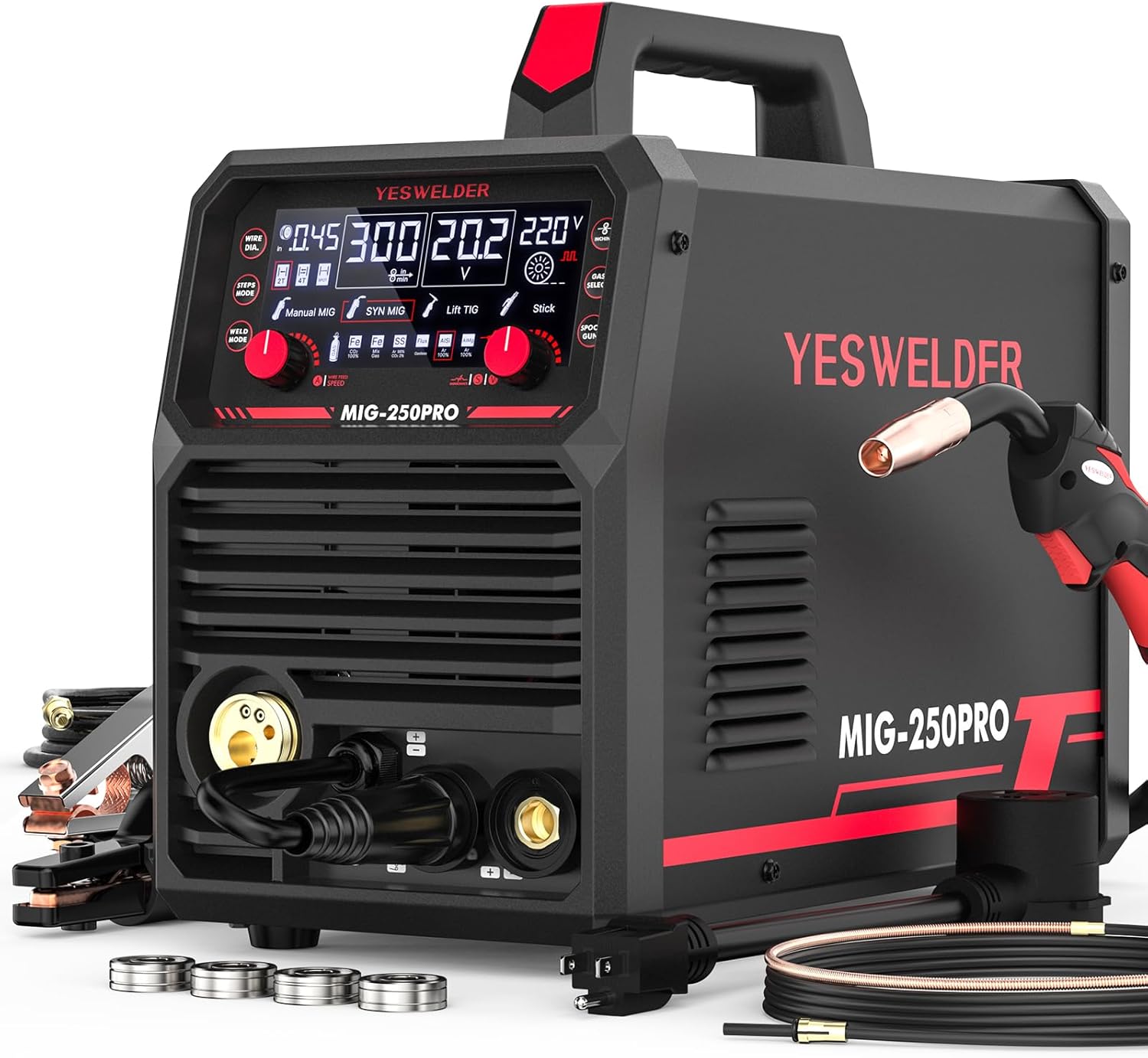
On 220 volts YesWelder rates it 250 amps at 60 percent, with pulsed mig and spool gun support, for well under the price of either Lincoln. The catch is documentation. The manual YesWelder links covers an older 220 volt only version, with a 34 amp maximum input and a 50 amp time-delay breaker. The machine sold now is dual voltage, rated 175 amps at 60 percent on 110, and its 110 volt input current is not published anywhere we could find. The page's FAQ mentions 50 amps. Treat it as a 240 volt machine.
Pros
- 250 A at 60 percent on 220 V; pulsed mig; spool gun support
- Breaker figure published for the 220 V version
- Two year warranty
Cons
- 110 V input current not published; the linked manual is for a different version
- Duty cycle temperature basis not stated
- Page and manual differ slightly on the 100 percent rating
Lowest price with gas mig
ARCCAPTAIN MIG160
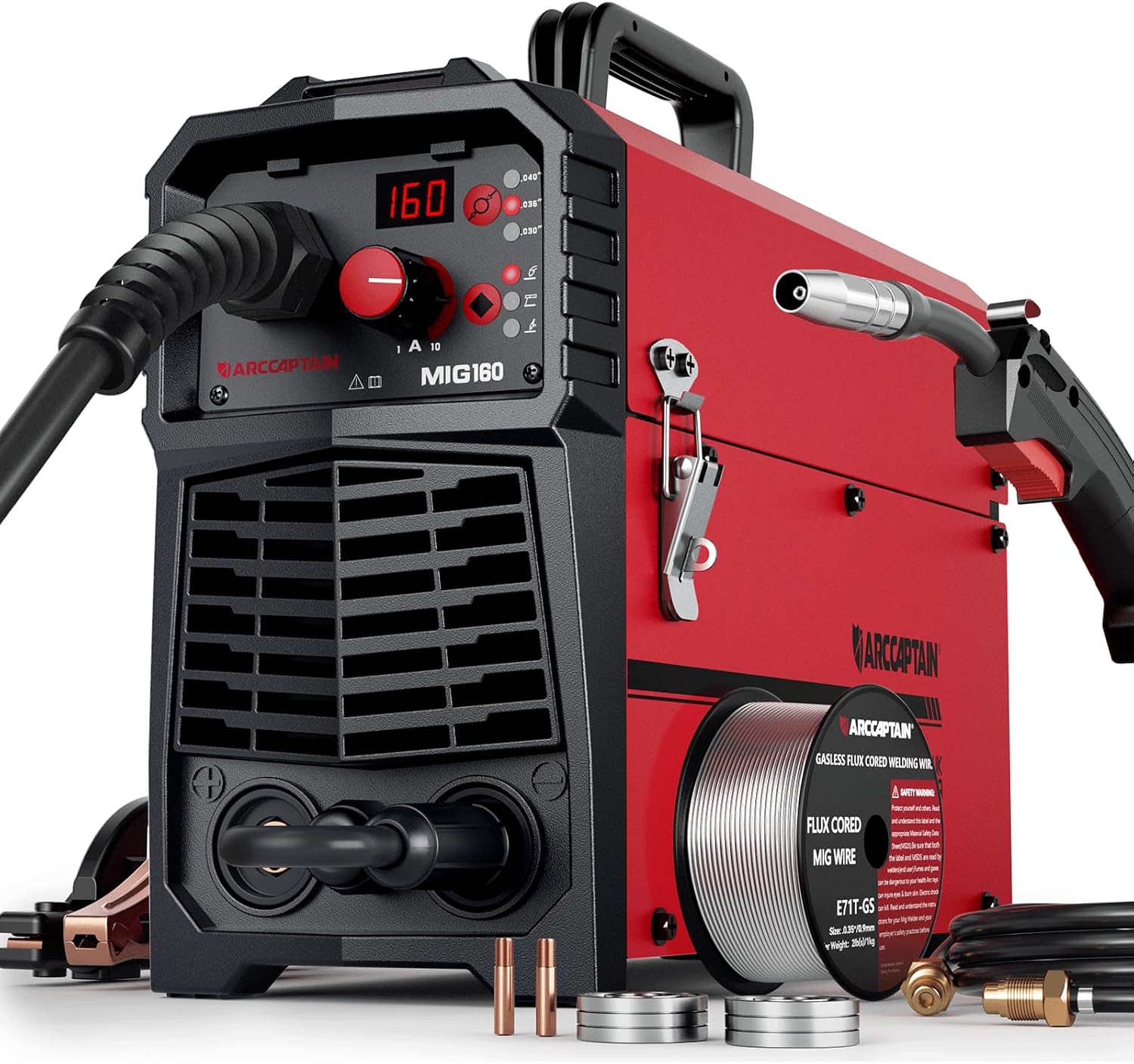
An 11.8 pound dual voltage machine that runs gas mig, flux core, stick and lift tig at the lowest price here. The nameplate rates mig at 120 amps at 60 percent on 110 volts and 160 amps at 60 percent on 220, with voltages stated. The manual asks for a 50 amp branch circuit and contradicts itself on input current: the parameter table says 47.6 amps on 110 volts and the nameplate says I1max 36.6. Either figure is far beyond a household outlet. It cannot run a spool gun or aluminum wire, and ArcCaptain publishes no maximum thickness.
Pros
- Gas mig capable at the lowest price band
- Duty cycle published with amperage and voltage at both inputs
- Circuit requirement stated; two year warranty
Cons
- Manual gives two different input currents for each voltage
- Asks for a 50 A circuit
- No spool gun support and no published thickness rating
Longest warranty among the imports
Weldpro MIG210LCD
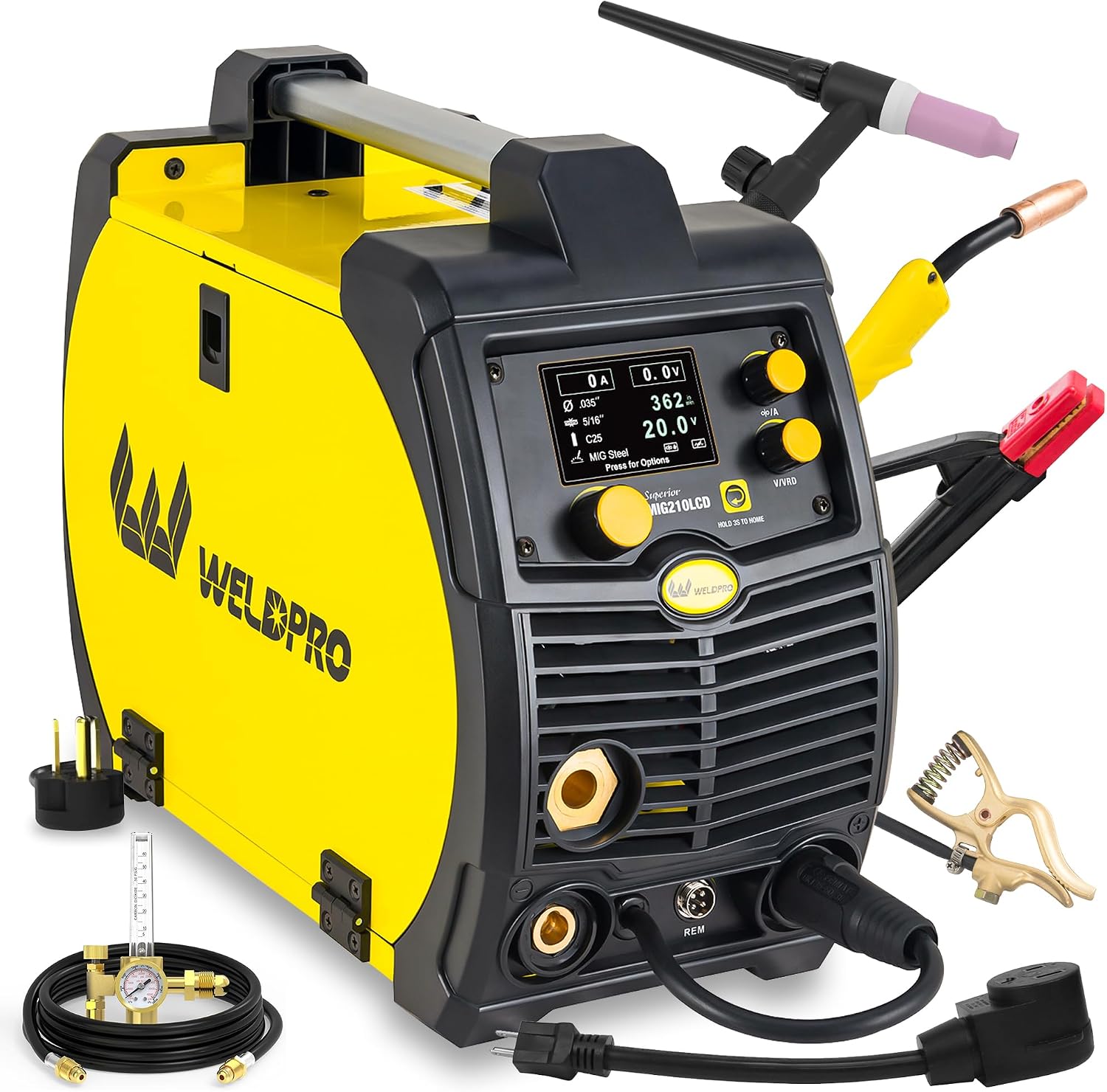
Weldpro rates it 200 amps at 30 percent on 230 volts and 120 amps at 30 percent on 115, which is three minutes of arc in every ten. That is a more modest claim than its import rivals make, on a proper spec sheet. Effective input is listed as 24.3 amps on 115 volts and 23 on 230, while the manual gives an unlabeled rated input of 35.7 for mig. No breaker guidance is published. The three year warranty is in writing.
Pros
- Spec sheet with duty cycle at a stated amperage per voltage
- Three year power source warranty
- Spool gun capable
Cons
- 30 percent duty cycle at rated output
- Two different input figures across its documents
- No breaker or wire guidance
Also worth considering
Strong, well-reviewed products that just missed our ranked list - worth a look if the picks above aren't quite right for you.
- Eastwood MIG 180 - The best documented budget machine we read: three duty cycle points per voltage, 24 A input on a 20 A outlet at 120 V, a 30 A minimum breaker at 240 V, and a three year warranty. Too few Amazon reviews to rank yet.
Frequently asked questions
What is the best mig welder for a home garage?
If you have household outlets only, a machine rated for a 20 amp circuit: of the five here, that is the Lincoln POWER MIG 140 MP or the Lincoln Easy-MIG 140. If you have or will add a 240 volt circuit, a dual voltage machine such as the YesWelder MIG-250 PRO gives far more output for less money.
Can a 120 volt mig welder weld quarter inch steel?
Makers publish a maximum thickness per model, usually with conditions. Lincoln rates the Easy-MIG 140 to 3/16 inch in a single pass with gas mig, and to 5/16 inch with flux core wire in multiple passes. We print those figures as published. A thickness rating describes what a machine can fuse. It does not say a joint will carry a load.
Why do the cheap machines claim a higher duty cycle than Lincoln?
They publish 60 percent at full output where Lincoln's Easy-MIG publishes 20 percent at 90 amps. What differs is the stated basis. Lincoln's POWER MIG 140 MP manual says its duty cycle at 40 C was determined by simulation from tests at ambient temperature. YesWelder and ArcCaptain give a working temperature range and do not tie the rating to it, so the figures may not be comparable.
Do I need a 50 amp breaker for a mig welder?
Only if the manual says so. The two Lincoln 120 volt machines here list a 20 amp fuse or breaker. The ARCCAPTAIN MIG160 manual asks for a 50 amp branch circuit, and the YesWelder MIG-250 PRO manual for the 220 volt version refers to a 50 amp time-delay breaker. Planning the circuit belongs to a licensed electrician.
Do these welders come with everything for gas mig?
All five can run gas mig, and the contents of the box vary. A gas cylinder is never included, and a regulator is not always. Check the listing for a regulator and gas hose, and budget for the cylinder, wire and safety gear.